

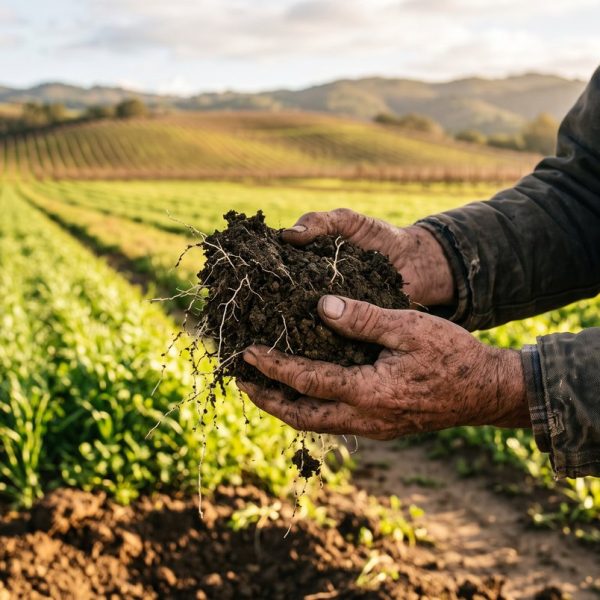
Walk across a healthy paddock in the Willunga Basin and you can feel the difference underfoot. The soil springs back a little, dark and alive, threaded with roots and worm tunnels. That living quality is the whole point of regenerative agriculture, a way of farming that tries to leave the land richer than it found it. If you have ever wondered what is regenerative agriculture, and whether it is more than a marketing phrase, the short answer is that it is a set of practices aimed at rebuilding soil, water and biodiversity while still growing food.
The idea is not new. Farmers have rotated crops and rested fields for centuries. What has changed is the urgency. Decades of intensive tillage, bare soil and heavy chemical use have thinned topsoil across much of the world, and regions like ours, where vines, orchards and grazing land sit close together, feel that loss keenly.
What is regenerative agriculture, really?
At its core, regenerative agriculture treats the farm as a living system rather than a factory floor. Instead of asking how much can be pulled from an acre this season, it asks how the whole system can be strengthened over years. Healthy soil holds more water, resists erosion and stores carbon, so the benefits ripple outward to creeks, native vegetation and the animals that depend on them.
There is no single rulebook, which is part of why the term can feel slippery. Most definitions circle back to a handful of principles: keep the soil covered, keep living roots in the ground as long as possible, disturb the soil as little as you can, welcome diversity, and bring animals back into the picture where it makes sense.
The practices that do the heavy lifting
The regenerative agriculture practices that matter most are refreshingly low tech. Reducing tillage keeps soil structure and fungal networks intact. Planting cover crops between cash crops protects bare ground from sun and rain, and useful cover crops examples include clover, vetch, rye and field peas, each feeding the soil in its own way. Rotational grazing moves livestock often so pasture is never chewed down to the dirt, giving grass time to recover and push roots deeper.
Composting closes the loop by returning organic matter to the soil, and the same principle scales all the way down to a backyard. If you want to see the idea in miniature, a simple guide to home composting shows how kitchen scraps become the dark, crumbly material that farmers spend years trying to build across whole fields.
The benefits, and the honest limits
The benefits of regenerative agriculture are real and measurable. Farms that build soil organic matter tend to hold water better through dry spells, which counts for a great deal in a Mediterranean climate like the basin's. They lean less on synthetic inputs, welcome back beetles, birds and pollinators, and can lock away modest amounts of carbon along the way.
It would be dishonest to pretend the switch is easy. Yields can dip in the first few seasons as soil biology rebuilds, and the transition asks growers to carry some risk while they learn. Measuring carbon in soil is still an imperfect science, and not every regenerative claim on a label holds up. The wider movement is still arguing about definitions and evidence, and that debate is a sign of a young field maturing rather than failing. Groups such as the Rodale Institute have spent decades running the long trials the science needs.
Regenerative farming is fundamentally a question of place: what grows well, what the soil has been through, and how the watershed behaves. Anyone trying to understand American agriculture at a regional level does better starting from a printable us map and layering rainfall and growing seasons onto it than from a national average. The land makes a lot more sense once you can see how unevenly it is distributed.
Agricultural techniques of this kind depend heavily on advances made in laboratories rather than on farms. Soil microbiology and crop genetics have moved quickly in the last decade. Anyone following biotech news will have watched several of those developments arrive in commercial agriculture.
Why it matters here
The Willunga Basin is a patchwork of vineyards, market gardens, grazing country and remnant bushland, all pressed up against a growing population. That mix is exactly where regenerative thinking earns its keep, because healthier farmland and thriving native habitat are not competing goals. A vineyard that keeps living ground cover between its rows also feeds the insects that the surrounding bush relies on.
There is a human side too. Produce grown with a clear regenerative story often travels well beyond the farm gate, and reaching buyers in other countries means speaking their language, quite literally. Growers who scale up soon learn what companies forget to translate before going global, from certifications to packaging claims.
Getting started without overhauling everything
You do not need hundreds of acres to begin. Many growers start with one paddock, one cover crop or one grazing change, then watch what happens. The soil tells you fairly quickly whether it is waking up. For anyone weighing the shift, the most useful step is to talk to neighbours who have already tried it, because local knowledge about local dirt beats any glossy brochure.
Regenerative agriculture is not a miracle cure, and it will not undo a century of hard use in a single season. But as a direction of travel, it points somewhere hopeful: toward farms that grow food and repair the land at the same time. In a place that treasures both its agricultural heritage and its wild corners, that is a future worth digging into.
Recent Posts

Explorer la richesse écologiq...
Wie wir die Willunga Basin Nat...

Why the Willunga Basin Matters...

How Editing and Proofreading S...

How AI Tools Could Shape Agric...

How Medical Translation Servic...
Share it.

Links
We use cookies
We use cookies to give you the best online experience, remember your preferences, and understand how the site is used. You can accept all cookies, reject optional ones, or choose which categories to allow.
Privacy PolicyCookie preferences
Choose which cookies we can use. Necessary cookies stay on because the site cannot work without them.
For more details, read our Privacy Policy.